







Autonomous and hands-free driving functions rely on an accurate understanding of where a vehicle is, where it is allowed to operate, and how it should behave within that environment.
Global Navigation Satellite Systems (GNSS) provides the only scalable source of absolute location. It anchors vehicles to digital maps, acts as a calibration and cross-check for other sensors, and enables wide ADAS operational design domains (ODDs) for automated driving. However, GNSS has historically been the “weak link” in challenging environments. In dense cities or roads with tree cover, GNSS is frequently degraded, making it unreliable for autonomous driving. Traditional metrics such as accuracy alone fail to capture the true operational risk.
In this article, we outline the dangers of “confidently wrong” GNSS, and how reliable GNSS enables safer autonomous vehicles. We also introduce FocalPoint’s S-GNSS® Auto software, which ensures GNSS reliability in the environments where it has previously failed.
GNSS reliability
GNSS reliability is the ability of the GNSS system to consistently deliver trustworthy positioning information across environments. It determines whether autonomous systems can trust their output and operate confidently in challenging environments.
The “Estimated Accuracy” Problem
When a GNSS receiver computes a position, it comes with an unknown error. After the fact, engineers can compare that position to a ground truth system and compute the actual error. But autonomous driving systems operate in runtime – and of course without an absolute ground truth system.
For that reason, GNSS receivers also output an estimated accuracy. This runtime estimate is critical for ADAS and autonomy because it determines how the system weights GNSS relative to other sensors (LiDAR, Cameras, IMU).
For ADAS and autonomy, the estimated accuracy is as important as the position estimate itself. It determines whether that position estimate is used for lane-level decision-making, coarse initialisation, or rejected entirely.
Traditional receivers can sometimes think they have a good, accurate position (low predicted error) when the actual error is high (read more about how this is visualised in the Stanford diagram). This “confident but wrong” state can be very dangerous in urban autonomous driving.
The risk of “confidently wrong” GNSS
A GNSS output that is confident but incorrect is more dangerous than no GNSS at all.
For autonomous systems, this means the system may fail without obvious warning signs. An incorrect absolute position can mislead planning and control. Relative sensors that may rely on GNSS for cross-check and calibration may not be able to detect inconsistencies.
The urban GNSS problem
Urban and semi-urban environments are hostile to GNSS. Buildings, sound barriers, vehicles, trees, and infrastructure reflect and obstruct satellite signals. A receiver may not always distinguish between direct line of sight and reflected signals and may use corrupt data to calculate a position. This might result in false confidence in incorrect information.
- The vehicle may believe it is in the wrong lane
- Map matching can fail catastrophically
- Sensor fusion systems may overweight corrupted GNSS inputs
The problem is amplified as autonomy advances, handing over more and more control to the system. At Level 3 “hands free, eyes off” autonomy, the system (not the driver) assumes responsibility for the driving task within the ODD. This increases the safety impact of localization failures, particularly those that go undetected.
This creates a fundamental challenge: How does the vehicle know when GNSS can be trusted—and when it cannot?
GNSS you can trust
FocalPoint’s S-GNSS® Auto changes how GNSS is processed. Rather than trying to “fix” a bad position after it is calculated, S-GNSS Auto operates at the measurement level using patented Supercorrelation® technology, passing on clean measurements to the navigation engine.
How it works
S-GNSS Auto creates a synthetic directional antenna in software, suppressing non-line-of-sight (NLOS) signals, and enabling the receiver to focus only on direct line-of-sight (LOS) signals.
These enhanced GNSS measurements can then be delivered to a navigation engine running on-chip or externally.
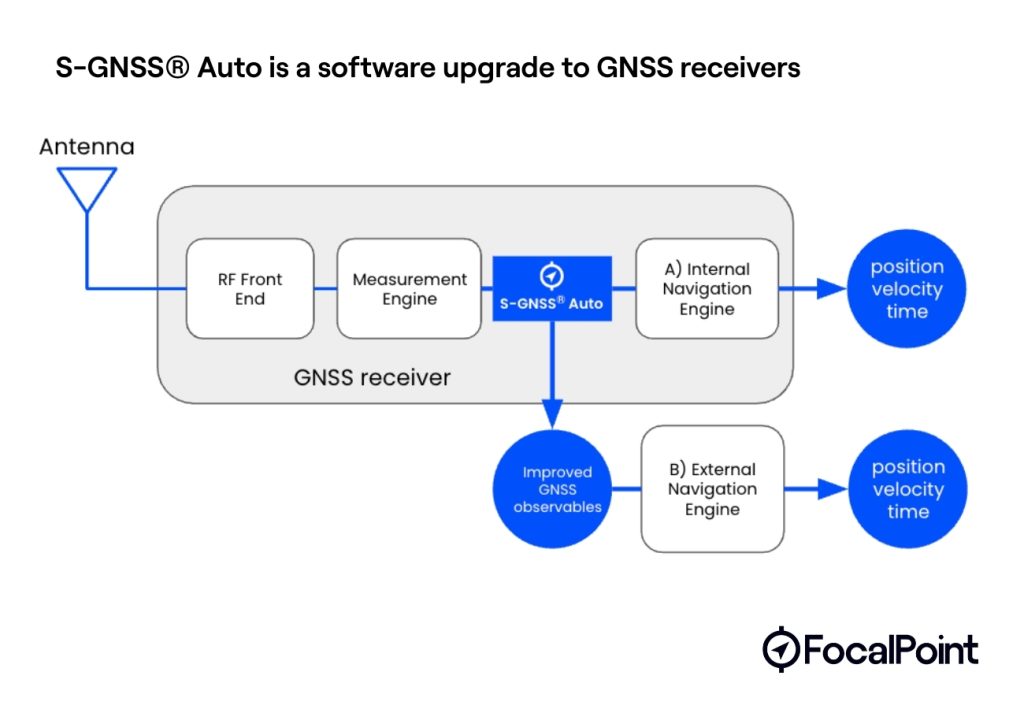
By providing cleaner measurements, S-GNSS Auto removes the corrupted data that causes position engines to output ‘confident but wrong’ estimates. Reliable GNSS helps ensure the autonomous driving system can correctly trust, de-weight, or reject GNSS inputs in real time as environments change. S-GNSS allows automotive OEMs to expand the range of environments and roads where they can offer ADAS and autonomy features — especially in urban canyons and under tree cover.
For autonomous driving stacks, S-GNSS Auto added to the ADAS system can help with:
- Fewer false alarms (triggering unnecessary disengagements)
- therefore improved user experience and customer satisfaction
- Fewer missed detections (not triggering disengagements when necessary)
- therefore fewer safety of life situations
Integrated onto STMicroelectronics’ Teseo
FocalPoint’s collaboration with STMicroelectronics brings signal-level GNSS intelligence to automotive-grade platforms. S-GNSS Auto has been integrated onto Teseo devices, bringing reliable GNSS to vehicles as a firmware upgrade. The joint solution has been tested in some of the world’s most challenging signal environments, setting a new benchmark for trustworthy positioning.
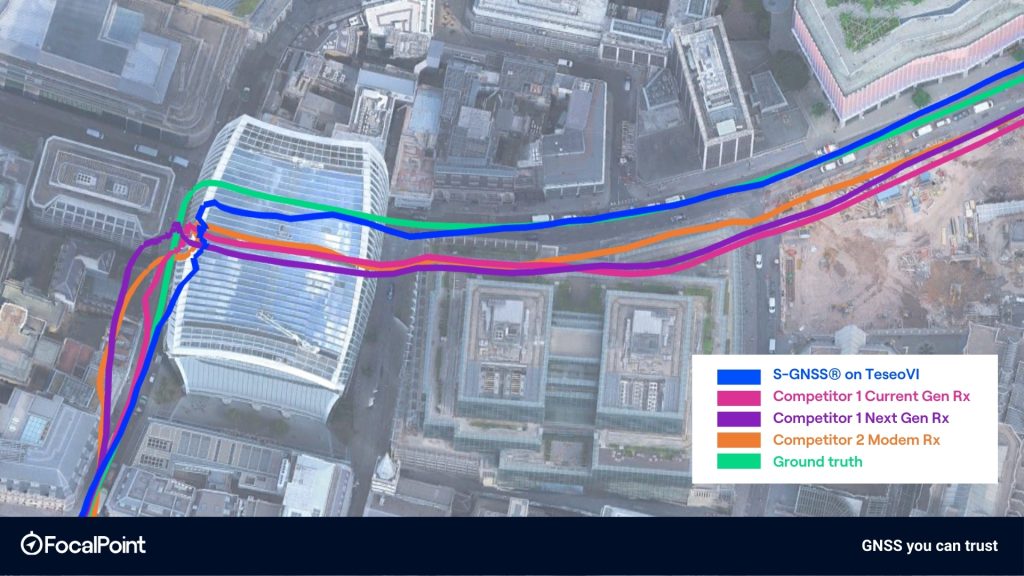
See our benchmarking results here
Autonomous vehicles cannot scale safely without trusted positioning. Through S-GNSS® Auto, FocalPoint enables a new standard of GNSS reliability aligned with the safety needs of automated driving.
Share this post

Ramya Sriram leads marketing at FocalPoint, a UK-based company that provides GPS-enhancing software for automotive, wearables and smartphones.
Related post
Video – Interview at Tech.AD Berlin: Manuel del Castillo on reliable GNSS
Manuel Del Castillo speaks at Tech.AD Berlin about how S-GNSS® Auto delivers the reliable positioning required for OEMS to offer autonomous driving features in challenging environments.