






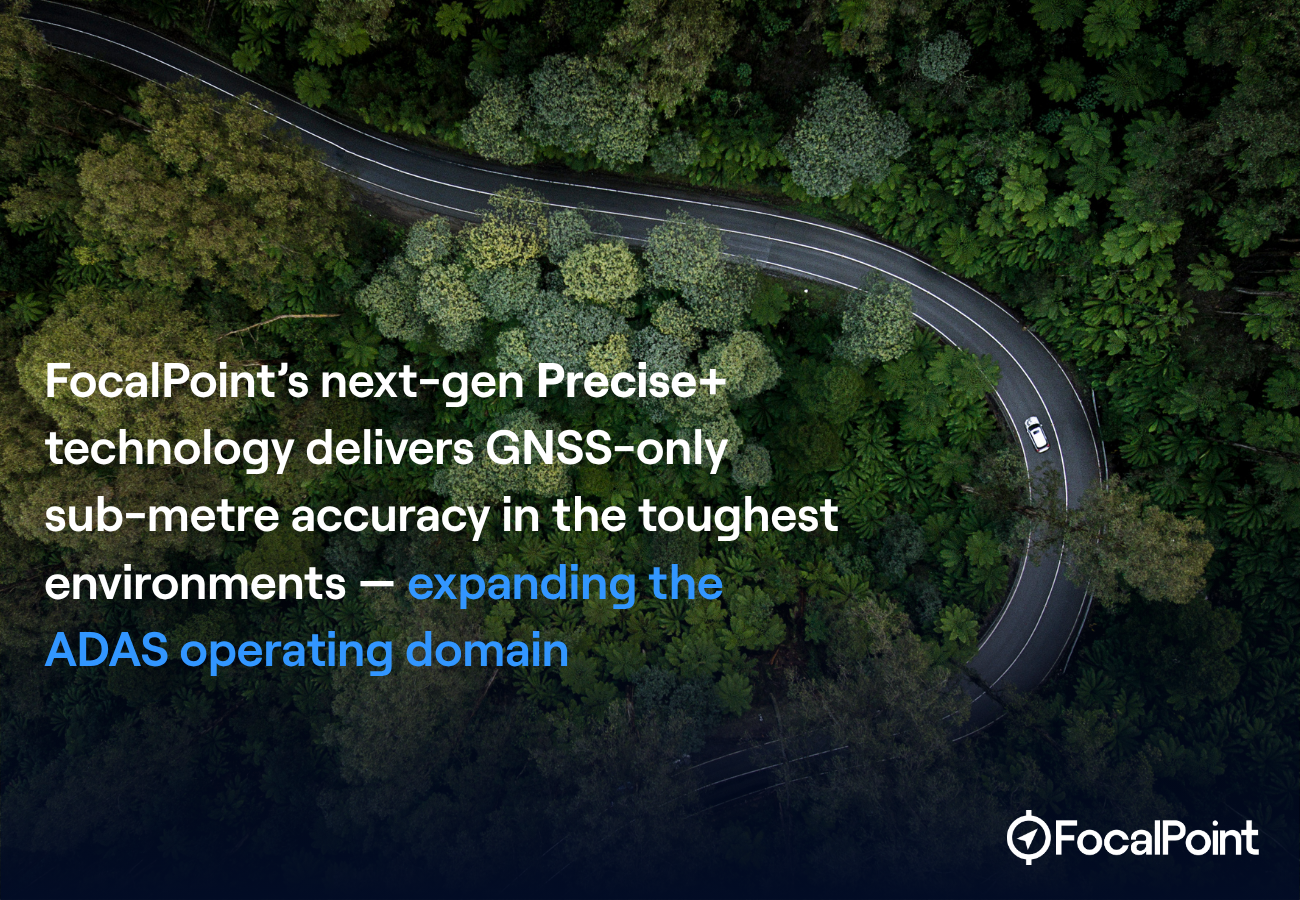
FocalPoint’s Precise+® helps customers get more from high-precision GNSS, achieving sub-metre accuracy in urban canyons and under foliage, where conventional carrier phase solutions fail. Precise+ delivers 80 cm accuracy at the 99th percentile where state-of-the-art receivers produce errors exceeding 3 metres.
Cambridge, UK — 27 April 2026 — FocalPoint, the UK-based developer of GNSS-enhancing software, today announced Precise+, a new technology that delivers reliable high-precision positioning in the tough environments where conventional carrier phase tracking fails. Unveiled at the European Navigation Conference 2026 in Vienna, Austria, Precise+ extends the benefits of the company’s patented Supercorrelation® platform into the carrier phase domain. It directly targets the cycle slips that cause RTK and PPP systems to lose lock in challenging environments.
Centimetre-level positioning depends on continuous carrier phase lock. When that lock is interrupted – a routine occurrence in dense cities, under tree cover, and in multipath-heavy environments – receivers suffer cycle slips and force the system to reinitialise. For automated driving and ADAS, robotics, and any application that treats lane-level accuracy as a safety requirement, these interruptions are the defining barrier to deployment at scale.
Precise+ solves the problem at its source. It brings the benefits of the company’s patented Supercorrelation® to precise GNSS positioning, fundamentally changing what is achievable in challenging environments: consistent sub-metre performance in conditions where state-of-the-art commercial receivers with live corrections deliver multi-metre errors.
The benchmark: Thetford Forest, under dense canopy. The company’s new Precise+ software-defined receiver was put to the test at Thetford Forest, a standard reference environment for GNSS performance under dense foliage. Precise+ delivered 80 cm accuracy at the 99th percentile — positioning error stayed below 80 cm across 99% of measurements in the most challenging conditions on the route. The figure below demonstrates performance under heavy foliage compared to commercial receivers running precise GNSS with paid correction services.
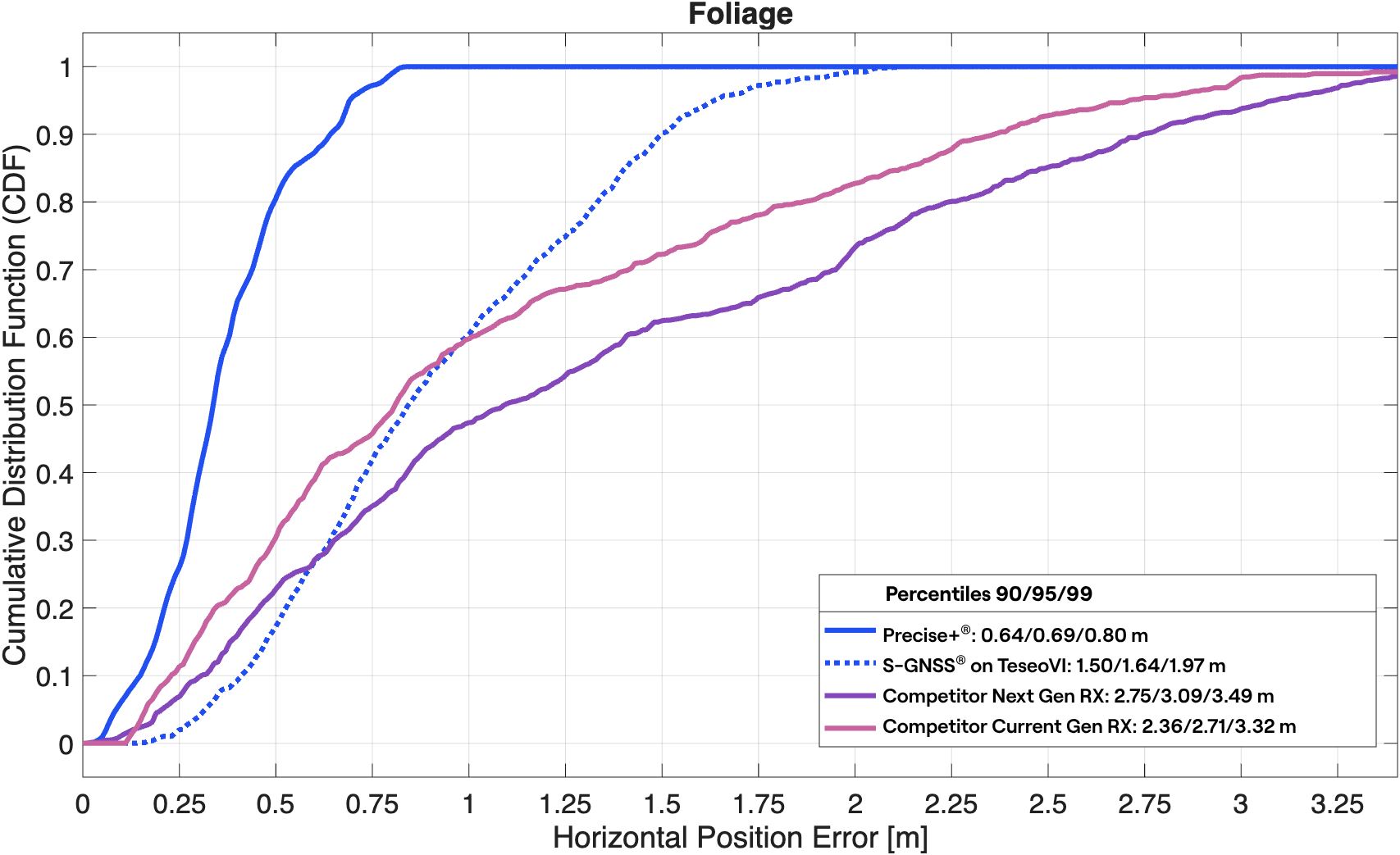
Inertial-free, GNSS-only results. The Precise+ results are pure receiver-level performance. No inertial sensors, dead reckoning or sensor fusion was used. This is a like-for-like comparison against competitor GNSS solutions, which means the gains Precise+ delivers compounds with whatever integrators choose to apply on top — including sensor fusion, RTK, or PPP corrections.
Precision across environments, not just open sky.
RTK and PPP deliver centimetre accuracy in open sky, but degrade sharply the moment signals are disrupted by tree cover, buildings, or multipath. For automotive OEMs, that means autonomy and ADAS features can only be safely deployed where high-precision GNSS reliably holds — a narrow slice of the road network, not the everyday environments their customers actually drive in. Correction services carry significant recurring per-vehicle costs, yet cannot fix what happens at the receiver when the signal environment degrades. The result: OEMs pay for precise positioning that does not work where it matters most.
Precise+ closes that gap at the receiver, in software.
By expanding the operating domain of high-precision GNSS, Precise+ lets OEMs deploy autonomy and ADAS features confidently across real-world driving conditions — and lets existing investments finally deliver value beyond open sky.
“Our customers have been paying for precise GNSS that stops being precise the moment conditions get difficult. Precise+ closes that gap. It is high-precision positioning that holds across the operating domains our customers actually drive in, delivered as software.” — Scott Pomerantz, CEO, FocalPoint
The scale of FocalPoint’s advantage is underlined by a second result from the same benchmark: the company’s existing S-GNSS® Auto software (integrated on STMicroelectronics Teseo devices) using standard, non-precise techniques also outperformed competitor receivers running precise GNSS with correction services. Supercorrelation’s ability to hold signal lock under foliage delivers strong performance even without corrections, and Precise+ brings that same resilience into the carrier phase.
Precise+ is targeted at automotive applications including ADAS, automated driving, and V2X, and is equally applicable to any system requiring sustained high-precision GNSS outside of open-sky conditions.
FocalPoint is working with leading chipset manufacturers to bring Precise+ to market. Contact us to learn more.
Share this post

Ramya Sriram leads marketing at FocalPoint, a UK-based company that provides GPS-enhancing software for automotive, wearables and smartphones.