






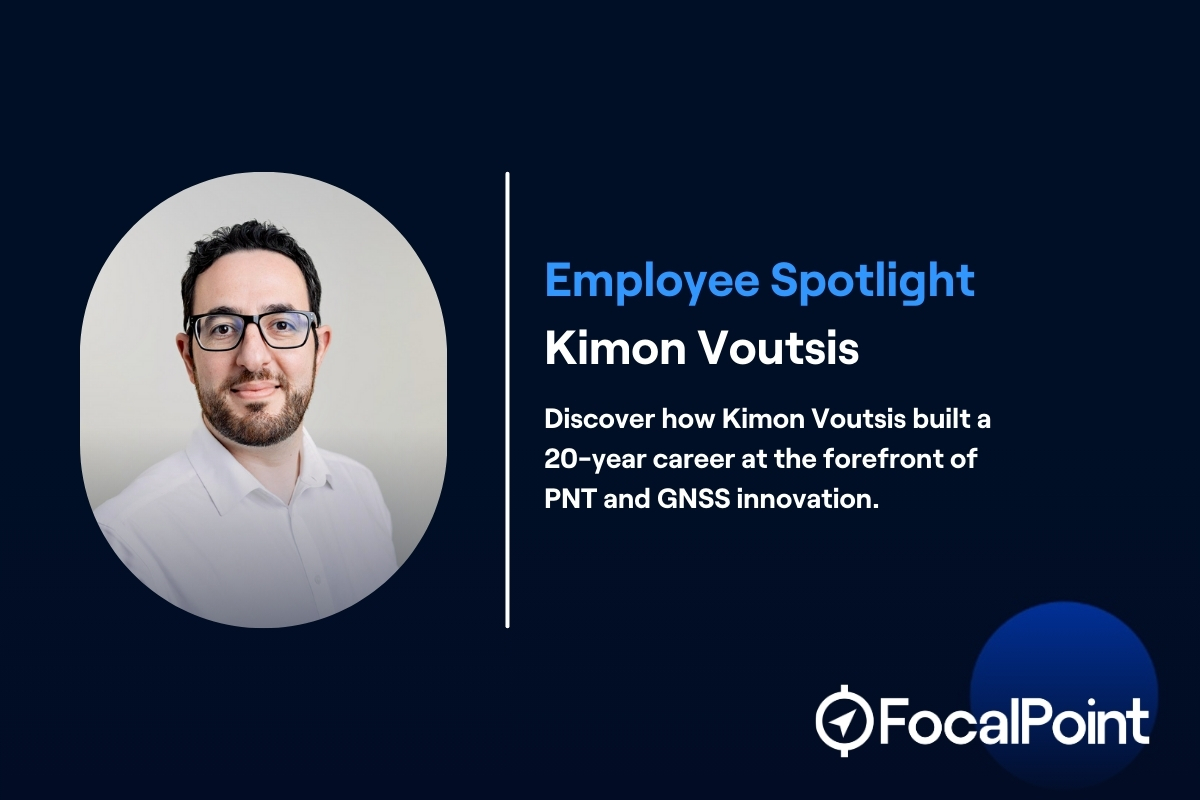
With two decades of experience in PNT and experience across academia and product management, FocalPoint Principal Engineer Kimon Voutsis has helped shape breakthroughs in GNSS reliability. In this interview, he walks us through his career evolution, his work on advanced GNSS at FocalPoint, and the technologies that excite him most.
1. Could you tell us a little bit about your career path so far?
I have been an engineer in the PNT space for 20 years, with industrial experience in roles such as technical consultant, engineering product manager and R&D in PNT applications.
2. What is your current role at FocalPoint and how has it evolved over time?
Over time, my role as a Principal Engineer has grown from hands-on field trialling, system testing, and streamlining data analysis to leading complex PNT projects, developing advanced algorithms, driving cross-functional team collaboration, and mentoring other engineers technically and in their career development.

3. Your research and career has been largely focussed around PNT and GNSS. What do you like best about working in this field?
PNT is an evolving field that transcends physics and engineering with many applications in daily life, from critical infrastructure to smartphone apps.
4. Can you walk us through your work on human motion modelling GNSS testing during your PhD at UCL? How did you apply that in your work at FocalPoint?
It was a very interesting interdisciplinary piece of work combining medical biomechanics research to develop a human motion model, with GNSS receiver development and DSP (digital signal processing) to analyse how human-induced motion impacts internal GNSS functions such as carrier phase and frequency tracking loops. The skills acquired from this PhD are relevant to my current job at FocalPoint as we design, develop, and test advanced GNSS algorithms and receivers for operation under challenging dynamic and environmental conditions.
5. You’ve been in academia, held technical engineering roles and you’ve also worked as a product manager. What were your unique learnings and challenges in these diverse roles?
Each of these roles requires a mix of hard and soft skills to address different stakeholder requirements and audiences with varying levels of technical expertise. Their common focus is solving real-world problems in PNT simulation and testing, along with systems integration and development.
6. Tell us a little bit about your experience working on FocalPoint’s S-GNSS® Auto software. What is unique about it and why is it a game-changer for GNSS reliability?
S-GNSS® Auto is a truly innovative product as for the first time, we can achieve high levels of GNSS performance in the most challenging environments, e.g. deep urban or under foliage, without using expensive antennas and inertial sensors.
7. As someone working remotely, how do you keep in touch with your colleagues and collaborate with your team?
We meet online daily and also in person at our Bristol and Cambridge offices for technical meetings and on-site training, as well as to maintain lab infrastructure and conduct field trials.
8. You were recently made a Fellow of the Royal Institute of Navigation – congratulations! What does this recognition mean to you?
I am proud of obtaining this recognition by the RIN. It motivates me to uphold a high standard in my work and support other engineers in their career growth and professional accreditation.
9. In your view, what is the biggest challenge to deploying accurate GNSS at scale today?
One of the greatest challenges is to protect GNSS assets from the ever-growing threats of cyberattacks, jamming and spoofing. Any GNSS deployment campaign, especially when it comes to critical applications, should carefully assess and mitigate these risks.
10. Can you share a project you worked on that you’re most proud of, and why?
11. What advice do you have for someone looking to advance their career – both in engineering and in research – in the PNT field?
It is important to learn about new developments in the field constantly and take any opportunities to expand their professional network, e.g. by becoming a member of the Royal Institute of Navigation and participating in industry events.
12. What emerging technologies excite you most in the PNT domain?
Machine Learning and Artificial Intelligence are emerging technologies which affect the PNT space. I believe that they will have a significant impact in the coming years, as demand for more reliable and accurate PNT solutions, under the most challenging conditions, will keep growing.
13. How do you stay up to date with the latest PNT research and applications?
By reading industry journals, magazines, attending webinars and online training as well as industry events in person. FocalPoint is a corporate member of the Royal Institute of Navigation, so there are many available training courses and networking events to participate in.
14. What do you do in your free time and what are your interests outside of work? I heard about your interest in campanology, which sounds fascinating!
Campanology (bell-ringing) at my village church is a fascinating hobby that encompasses technical, physical and musical skills. It is also a great way to involve myself in the local community.
Share this post

Ramya Sriram leads marketing at FocalPoint, a UK-based company that provides GPS-enhancing software for automotive, wearables and smartphones.