






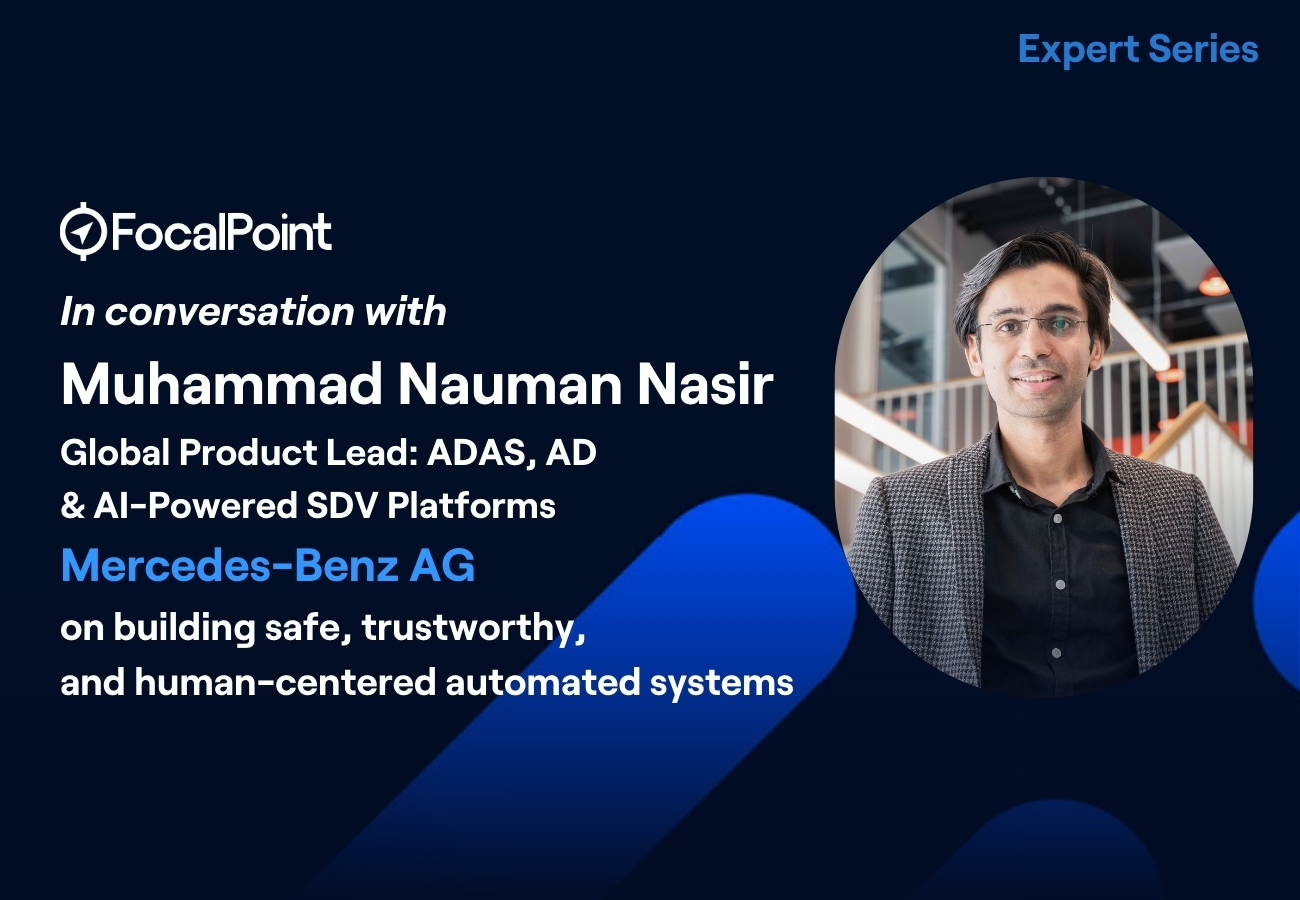
In this interview with Focal Point Positioning, Muhammad Nauman Nasir, ADAS lead at Mercedes-Benz, explains how cutting-edge vehicle autonomy balances innovation, safety, and trust – emphasising that in ADAS, every line of code carries a moral as well as technical responsibility.
Q1. Take us through your journey from your early engineering days at Harman through Bosch and Aptiv to leading ADAS product management at Mercedes-Benz. Are there any projects you’re particularly proud of?
My journey has always been about connecting dots between technology, people and purpose. I started as a software engineer fascinated by embedded systems at Harman, Visteon and Bosch. Vehicles were beginning their transformation from mechanical machines into intelligent, software driven platforms and I wanted to be inside that transformation, not watching it from the outside.
At Aptiv, I moved deeper into autonomy, sensor fusion, trajectory planning, Level 3 and 4 architectures. That was my shift from feature development to true systems thinking. I joined as part of a core team of few engineers. We scaled that team globally. That experience permanently changed how I see leadership: technology scales through talent, not just architecture.
At Mercedes-Benz, everything became transformational. I contributed to launching MB.OS; our software-defined vehicle platform and to delivering DRIVE PILOT, the world’s first legally certified Level 3 autonomous driving system to production with zero critical defects.
But what I am most proud of isn’t a single feature or a single launch. It is helping shift a 100-year-old automotive icon into a software company with safety at its core. MB.OS today powers over 10 million vehicles. That scale makes you understand what it truly means to build not a feature but a foundation.
Q2. ADAS technology sits at the intersection of innovation and safety-critical systems. How do you balance the push for cutting-edge features with the absolute necessity of reliability and safety?
In ADAS, innovation without safety is not ambition, it is irresponsibility. Every single line of code must be written with a human life in mind. That sounds like a constraint. It is actually the most clarifying design principle you can operate with.
The rule I live by is simple: you don’t ship a feature because it’s impressive, you ship it because it’s trustworthy. That is the difference between a demo and a product. Innovation asks “What’s possible?” Safety asks “What’s predictable and controllable?” The art of this work is holding both questions in tension, simultaneously, without flinching.
The real friction isn’t between safety and innovation, it’s between speed and thoroughness. We resolved it by investing in architecture upfront: ISO 26262 compliance, rigorous SIL/MIL/HIL validation pipelines, AI-driven DevOps. When your foundation is unshakeable, you can innovate faster, not slower. Safety accelerates, it doesn’t brake.
My personal line in the sand: if I wouldn’t put my own family in this vehicle today, we are not shipping. That standard sounds extreme. It keeps people alive. Safety isn’t a constraint, it is the design philosophy itself. Build trust and innovation scales. Break trust once and it collapses. That is not a technical position. It is a moral one.
Q3. You’ve worked across autonomy levels from L2+ to L4. How do the technical and regulatory challenges change as you move up those levels and how do they impact liability/insurance?
Each autonomy level isn’t just a technical upgrade, it is a transfer of responsibility. At L2, the human remains in the loop: the system assists, the human decides.
- At L3, the machine conditionally takes the wheel and that single shift creates a legal earthquake. Who is liable when the car makes a decision and that decision causes harm?
- At L4, the system operates independently within defined domains.
Technically, complexity grows exponentially as you move up the stack. Redundancy becomes mandatory. Fail-operational systems are required. Scenario coverage explodes from thousands to millions of edge cases. The architecture must be designed not just to perform but to fail gracefully, predictably and safely.
Regulatory and insurance frameworks must evolve in lockstep. The higher the autonomy, the more responsibility migrates from the driver to the system, shifting from consumer insurance to product liability and B2B risk models. Regulators stop asking “Does it work?” and start asking “How does it fail?” That is a fundamentally different conversation and it demands a fundamentally different engineering culture.
What I always say is this: we are no longer just engineering systems, we are engineering ethics at scale. Autonomy is not a product. It is a partnership between humans, machines and policymakers. The higher the level of autonomy, the more that partnership demands trust and trust is built through transparency, accountability and radical honesty. Not just through technology.
Q4. How can OEMs balance cost, safety, and redundancy when designing sensor suites?
This is one of the most practical and underappreciated challenges in the industry. The natural instinct is to add more sensors in the name of safety. But more sensors mean more cost, more power draw, more data to process and counterintuitively, more potential failure points. The answer isn’t more. It’s smarter.
Redundancy doesn’t mean stacking hardware. It means intelligent architecture. The winning philosophy is minimum necessary redundancy with maximum validated coverage. You don’t design a sensor suite for what might happen in a test lab, you design it for every edge case that can occur at 3 a.m. in a rainstorm on an unmarked rural road. That’s a data and software challenge as much as it is a hardware one.
The future belongs to platform thinking, software-driven perception fusion, modular sensor architectures that scale from entry-level to flagship and AI models trained on real-world complexity rather than controlled scenarios. We optimize cost not by cutting corners but by designing systems that are reusable, validated once and deployed everywhere.
Cost discipline and safety are not opposites. They never were. Good systems engineering aligns both and the OEMs that internalize that truth first will have a structural cost advantage that compounds across every future platform generation.
Q5. As the pace of innovation accelerates and new OEMs enter the market, what do established automakers need to do differently to remain relevant?
Legacy automakers carry an asset that most new entrants profoundly underestimate: trust. Decades of safety records, deep regulatory relationships, global manufacturing strength and hard earned customer loyalty. That trust is a genuine moat but only when paired with transformation. Trust without transformation becomes complacency. And complacency, in this era, is fatal.
The established OEMs that will lead are the ones that learn to operate simultaneously at two speeds: the long-cycle discipline of safety-critical hardware development and the short-cycle agility of a software company. That is not a technology challenge. It is a cultural revolution and cultural revolutions are harder than engineering ones
Three things will define who leads the next phase.
- Think like a software company, not just hire software engineers, but genuinely rewire how decisions are made, how products are shipped and how talent is valued.
- Build ecosystems, not internal silos become orchestrators of platforms, not just manufacturers of vehicles.
- Lead with purpose beyond horsepower. The best products in the next decade will be defined by what they give back to human life, not just what they can do on a track.
And the talent war is decisive. The world’s best software engineers are joining a company which offers them the mission, the autonomy and the tooling of a world-class tech firm. The companies that crack that code will define the next century of mobility.
Q6. Why is collaboration so crucial in this space — as seen most recently at your participation in CoMotion Global in Riyadh?
No single company will solve autonomous mobility alone. The system is too complex, the stakes too high and the regulatory map too fragmented across geographies. When I joined CoMotion Global in Riyadh, what struck me most wasn’t the technology on display, it was the quality of conversation happening between governments, OEMs, city planners and technology companies in the same room, at the same time. That combination is rare. And it is absolutely necessary.
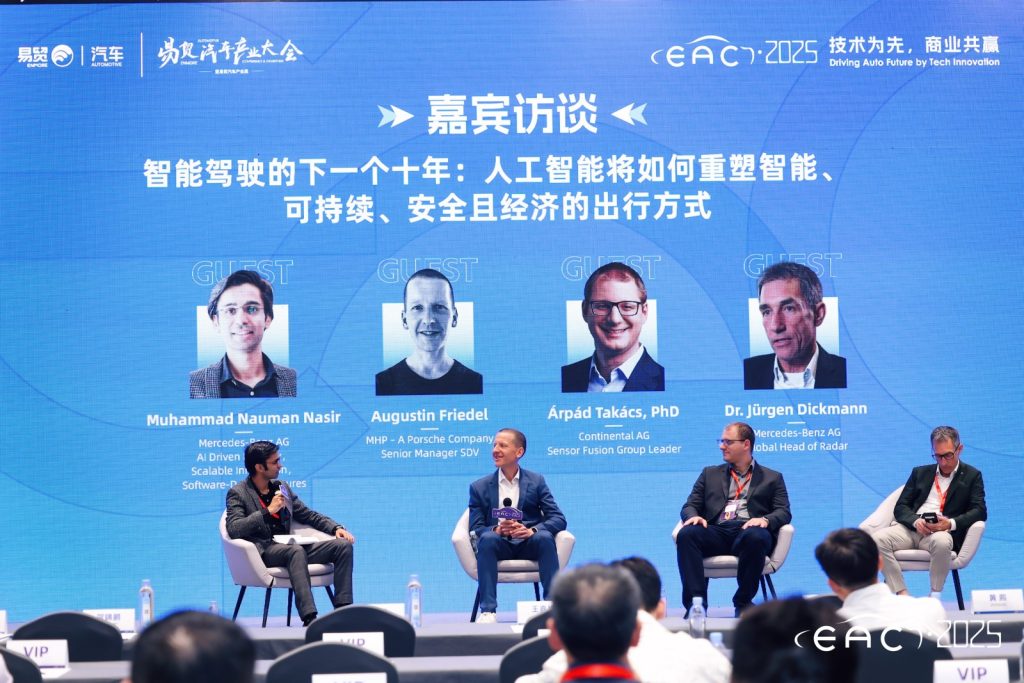
Mobility is no longer an industry, it is an ecosystem. Autonomy simultaneously touches infrastructure, telecom, cloud, regulation, insurance and urban planning. You cannot engineer your way through that complexity alone, no matter how brilliant your team is. Collaboration reduces fragmentation and accelerates the standards alignment that allows trust to scale across borders and across industries.
Your competitor in one domain is often your most strategic partner in another.
I’ve co-led industry alliances with companies. Every partnership taught me the same lesson: your competitor in one domain is often your most strategic partner in another. Shared safety standards, shared infrastructure investments, shared anonymized data, these are not competitive losses. They are how the entire industry moves faster without anyone cutting corners on safety.
We live in a world where complexity is accelerating faster than any single organization can absorb alone. In that environment, smart collaboration is not a soft strategy. It is the only durable survival strategy. The companies that build the most trusted, open ecosystems will define the rules everyone else plays by.
Q7. Why are Over-The-Air software updates so critical for modern ADAS and autonomous systems? What do they enable that wasn’t possible before?
Before OTA, a vehicle was a static product. You bought it, you drove it and the software on Day 1 was the software for life unless you paid for a dealer visit. That model was broken. It was always broken. We simply tolerated it because we had no alternative.
OTA transforms vehicles from static products into living systems. It reduces update deployment times from days to minutes. A safety improvement that would previously have required a full physical recall, costing potentially hundreds of millions of euros, can now reach millions of vehicles overnight with a single software push. Fewer recalls. Fewer workshop visits. Lower carbon footprint. Better safety outcomes. That is not a feature. That is a paradigm shift.
But the deeper transformation is philosophical. OTA changes the relationship between an OEM and its customer, from a one-time transaction into a continuous, evolving ownership experience. It is the bridge between the automotive industry and the subscription economy. Features evolve post-sale. AI models improve continuously. The vehicle you own in year three is genuinely better than the vehicle you bought in year one. That is a fundamentally new value proposition.
And when you overlay Agentic AI on top of OTA, the vehicle doesn’t just get updated, it gets smarter with every cycle. That is not a feature. That is the future of the entire automotive business model.
Q8. You recently launched the Co-Pilot Mindset newsletter. What inspired that, and what aspects of AI are you most excited to explore?
The Co-Pilot Mindset was born from a growing frustration, one I saw across the industry and felt honestly in myself. Too many conversations about AI swing between two dangerous extremes: either AI will replace us all and we should be afraid, or AI is merely a productivity tool and we should be grateful. Neither framing is right. Neither is useful. Both miss the point entirely.
My core belief is that the most powerful human-AI configurations are the ones where AI amplifies human judgment rather than replaces it. When autopilot engages on a commercial flight, the pilot doesn’t disappear, the pilot is freed to focus on the decisions that truly matter. That metaphor is the mindset I want to spread. Not just in mobility. Everywhere.
AI should not replace human judgment, it should elevate it. That is the Co-Pilot Mindset.
What excites me most right now is the convergence of Agentic AI and Physical AI. Agentic systems that can complete full missions autonomously across complex, multi-step workflows, not just answer questions, but act with intent and judgment. And Physical AI, where intelligence moves off the screen and into the real world: vehicles, robots, smart infrastructure. The intersection of those two trends with mobility is where the most consequential innovations of the next decade will happen.
The newsletter is my way of thinking out loud at that frontier and inviting others into the conversation. Because the next decade isn’t about autonomous cars in isolation. It is about AI powered ecosystems where humans remain in control of purpose, values and ethics. That is the world I am building toward.
Q9. You’ve spoken about mobility needing orchestration across cities and infrastructure. How do you see urban planning influencing AV adoption?
Autonomous vehicles don’t exist in a vacuum. They exist on roads, in cities, alongside pedestrians, cyclists, delivery robots and emergency vehicles. The belief that you can achieve full autonomy without transforming urban infrastructure is the industry’s most persistent and ultimately most costly myth.
The car is no longer an island. It is a node in the city’s nervous system. A self-driving vehicle can only be as intelligent as the data environment it operates within. If road markings are faded, if traffic signals don’t communicate digitally, if the city has no V2X infrastructure then the most sophisticated AV stack in the world is operating partially blind. Brilliant technology inside a broken environment produces mediocre outcomes.
The technology ceiling for autonomous vehicles is set by the infrastructure floor of the cities they operate in. The cities that understand this are already moving with urgency.
When cities and vehicles genuinely communicate with each other in real time, we don’t just get self driving cars, we get orchestrated mobility that can eliminate systemic congestion, reduce urban emissions at scale and return meaningful time to human lives every single day. That is not a vehicle story. That is a civilizational one. And companies must show up as true partners in building that future not just as vendors selling hardware into it.
Q10. What’s your perspective on where we currently stand in the journey toward fully autonomous vehicles? What are the realistic next milestones versus the hype?
We are between maturity and hype correction.
Here is what is genuinely, demonstrably real right now: L3 is commercially deployed and legally certified on public roads. Robotaxis are operating at meaningful scale in multiple cities without safety drivers in the vehicle. L4 is live in geofenced urban environments today. These are not demos. These are products in the hands of real customers. That progress deserves full acknowledgment.
The realistic milestones over the next three to five years are: broader L3 certification expanding across Europe and Asia-Pacific, accelerating L4 robotaxi deployment into additional urban corridors, and the commoditization of L2+ safety features across mass-market vehicles globally. Those milestones are achievable. Those are happening right now.
The industry is shifting from asking “Can we do this?” to asking “Can we deploy this safely, sustainably and profitably at scale?” That is not a retreat from ambition. That is the maturity the industry needed. And ubiquitous, reliable L3 and L4 in well-mapped corridors by 2030 will save hundreds of thousands of lives annually. That alone makes every year of this work worth it.
Q11. “I believe technology should simplify, protect, and empower humans — and the next decade of mobility will be built this way.” Can you elaborate on that vision?
Technology should simplify, protect & empower.
Most technology in history has been designed around what is technically possible. What I am arguing for and actively building toward is technology designed around what is humanly necessary. There is a profound difference between those two orientations. One produces impressive systems. The other produces indispensable ones.
- Simplify means the best technology is invisible. You don’t think about your seatbelt as you drive. You don’t consciously feel your anti-lock brakes engage when you stop suddenly on ice. Great ADAS should feel exactly the same way not like a feature you are actively using but like a quiet layer of intelligence you simply forgot was there. Invisible, seamless, essential.
- Protect means that in a world of accelerating complexity, technology must be a shield not a new source of anxiety. For mobility, this means systems that protect you not just from accidents but from data breaches, system failures and the misuse of automation. Safety extends far beyond the physical.
- Empower means expanding what humans can do with their most finite and irreplaceable resource: time. A vehicle that drives itself on a highway frees a commuter to think clearly, connect deeply or simply rest. Multiplied across billions of journeys, that is one of the most profound human empowerment opportunities in modern history. Not convenience. Restoration of human capacity.
The next decade of mobility will not be defined by speed or horsepower. It will be defined by trust, sustainability and human-centered AI. If mobility doesn’t genuinely improve human life, not just technically impress it, we have missed the point entirely. We protect the body, simplify the journey and empower the soul to focus on what truly matters. That is the legacy I am building toward.
Q12. You offer mentorship to people entering this field. What skills, mindset, or experiences should aspiring ADAS engineers focus on developing?
The first thing I tell every person I mentor: learn to be genuinely comfortable with uncertainty. This field moves faster than any textbook, any curriculum or any certification program can keep pace with. The engineers who truly thrive are the ones who have mastered how to learn, not just how to execute what they already know. In a world that is volatile, uncertain, complex and ambiguous, the only lasting competitive advantage is the ability to learn, unlearn and relearn continuously and without ego.
In terms of technology, three pillars:
1. Systems thinking : Understand the full stack
2. Safety mindset : Engineering is responsibility
3. Human empathy : You are building for real lives
Build an entrepreneurial mindset. The era of stable, single-discipline careers is ending. The engineers who will thrive over the next two decades will be multidimensional, they understand systems, understand people, understand business strategy and carry genuine ethical conviction about the consequences of the work they do.
And above all, develop your ethical compass early and protect it. Autonomous driving systems will make life-and-death decisions at scale, affecting millions of people who never chose to interact with this technology. The engineers building these systems carry a moral weight that most professions will never know. People who want to build a genuinely safer world. Good products are built by people who truly care for the people who will use them. Build technology for the sake of humanity, not technology for the sake of technology. That distinction is everything.
DISCLAIMER: The views and opinions expressed in this chapter are solely those of the author and do not necessarily reflect the views, policies or strategies of the author’s employer or any affiliated organization. The content is provided for
informational and educational purposes only and should not be construed as official guidance or endorsement by the author’s firm or its affiliates.
Share this post

Ramya Sriram leads marketing at FocalPoint, a UK-based company that provides GPS-enhancing software for automotive, wearables and smartphones.
Related post
Jammertest 2025 Results: How FocalPoint’s Supercorrelation® Defends Against Spoofing
A first look at the results from Jammertest 2025 in Norway, which demonstrate how Supercorrelation® enhances GNSS receiver resilience to spoofing attacks.