
- Products
- Solutions
- Ecosystem
- Resources
- About Back
About
About
About FocalPoint: our history, milestones and leadership team.
Our Purpose
Our purpose is to improve the lives of everyone who relies on positioning technology.
Careers
Learn about life at FPP, our impact, and what we offer. Hear from our people about our values and what they like about working here.
Sustainability
Read about our commitment to building a sustainable future.
Recognition






- Contact
The technology
What is S-GNSS® Auto and how does it work?
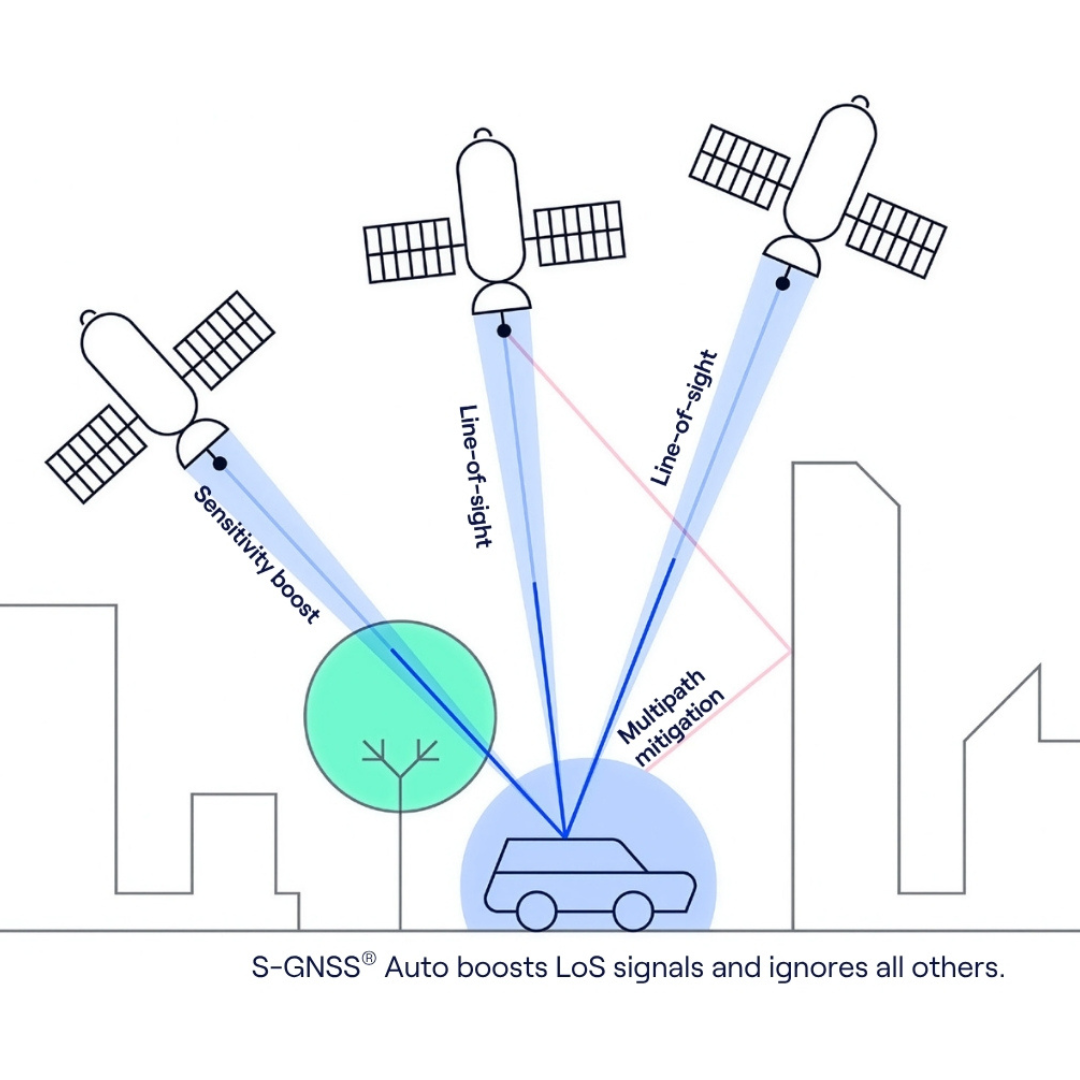
S-GNSS® Auto is a software upgrade for GNSS receivers. Working directly from the chip, it boosts GNSS accuracy and reliability, enabling safer navigation and autonomy in urban areas and forest roads. It uses FocalPoint's patented Supercorrelation® technology to boost line-of-sight signals and reject non-line-of-sight signals.
What is Supercorrelation®?
Supercorrelation is FocalPoint's patented technology that discriminates the angle-of-arrival of satellite signals, allowing GNSS receivers to focus on line-of-sight signals while ignoring all others, without the need for high-cost antennas.
Conventional GNSS receivers can only perform a small amount of coherent integration, typically less than 20 milliseconds. Supercorrelation overcomes these limitations to enable long coherent integration (typically 1 second or more) with motion compensation, even on low-cost hardware.
Operating between traditional GNSS correlators and the navigation engine, it creates a high-performance synthetic antenna, mitigating multipath and improving positioning reliability in challenging environments.
Learn more in the Supercorrelation Technical Overview.
Where does the software sit in the system architecture?
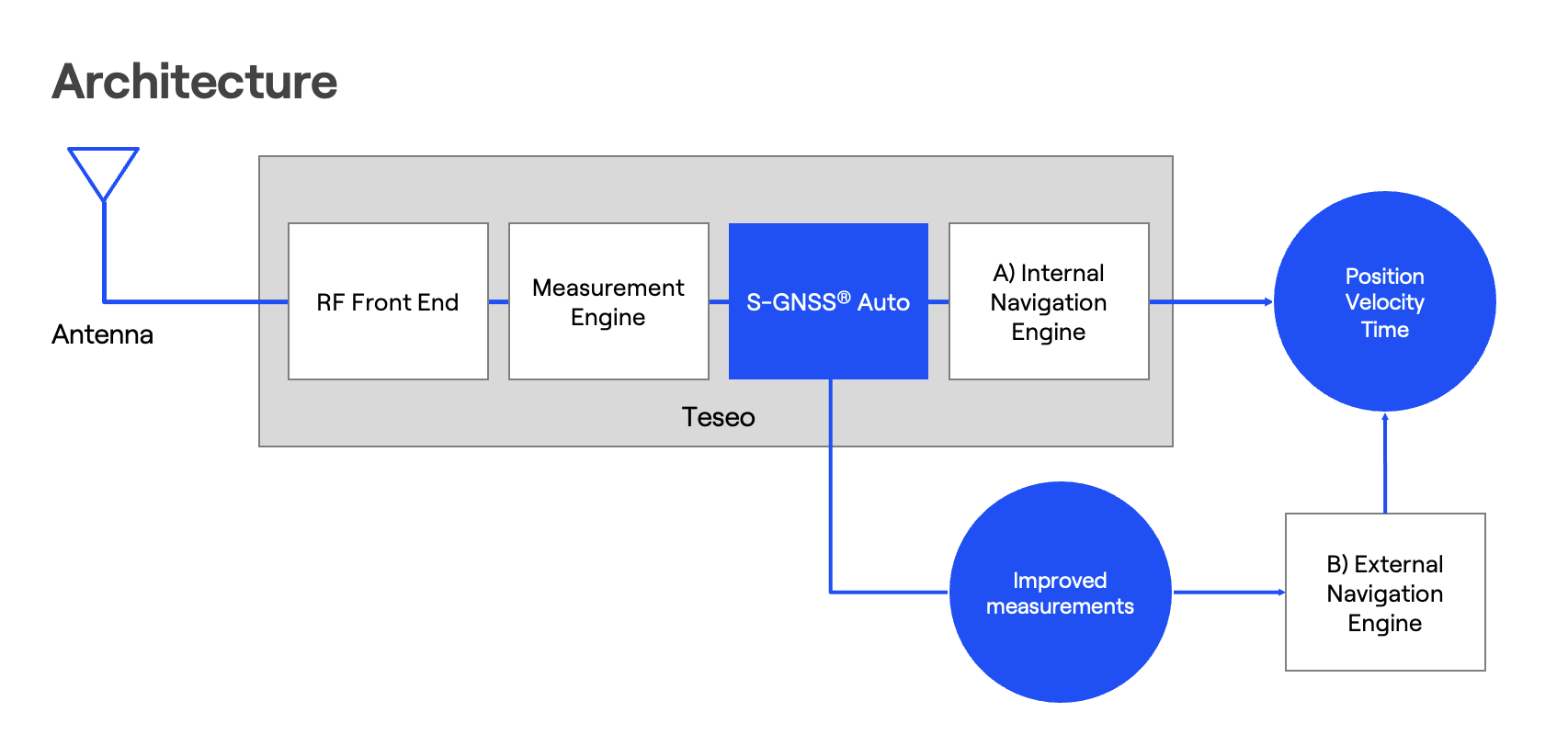
S-GNSS Auto is applied as a firmware upgrade to the measurement engine. Enhanced measurements are provided to the Navigation Engine (internal or external), where improved position and velocities are calculated. The video shows where S-GNSS® Auto is integrated on STMicroelectronics’s Teseo receivers.
Benefits & performance
Why is GNSS critical for autonomy?
GNSS is the only sensor providing an absolute position anywhere in the world. Wheel odometry, lidar, IMU and cameras are excellent at short-term relative motion but accumulate error over time and need an external reference to correct against. Even in an architecture where GNSS isn’t the primary sensor, it still matters that it works as well as possible: a poor-quality reference degrades the sensors that lean on it. S-GNSS® Auto makes that reference reliable in the environments (urban canyons, foliage) where it would otherwise fail silently.
Our current GNSS solution is good enough. What added benefits can we see from your solution?
Today’s automotive use cases are advancing fast. Each step up demands more reliable positioning than current GNSS solutions can guarantee. This is especially true in urban or foliage-heavy environments, where GNSS typically degrades. Our software mitigates that degradation, bringing GNSS performance close to open-sky levels.
That reliability is what lets you expand ADAS and automated driving features beyond open-sky into a much broader network. With performance validated across diverse environments (including trials on three continents), we help you scale ADAS coverage confidently, rather than being limited by unreliable systems.
My company is moving away from reliance on GNSS as we don’t think it is suitable for autonomy requirements. How will S-GNSS change that?
This is exactly why we developed S-GNSS® Auto. Conventional GNSS has been unreliable in challenging environments, limiting its use in autonomy features. S-GNSS changes this by turning GNSS into a reliable input to the ADAS system. By rejecting reflected signals and boosting direct ones, it ensures only trustworthy measurements reach your positioning engine. And because the receiver’s own uncertainty estimate reflects reality more closely, the system can trust the fix when it’s good and de-weight it honestly when it isn’t. The result is a trustworthy output that the rest of the system can rely on across everyday driving environments.
How does S-GNSS affect my antenna choice or placement?
S-GNSS does not constrain your antenna choice. It expands your options.
Supercorrelation improves receiver sensitivity and enables the receiver to discriminate line-of-sight signals from reflections. In effect, it upgrades the antenna you already have. That gives you three ways to use the improvement: pick the one that suits your programme, or split the benefit between them.
- Keep your antenna, gain performance. The same antenna in the same location delivers better accuracy and reliability.
- Keep your performance, reduce your cost. Specify a lower-cost, lower-spec antenna (or a less good placement) and hold your current performance level, or improve on it.
- Keep your performance, gain design freedom. Place the antenna where packaging, styling or aerodynamics want it, rather than where RF performance demands it, including concealed and otherwise sub-optimal locations.
The strongest example is band selection. S-GNSS on an L1-only antenna surpasses the performance of a conventional L1 + L5 receiver, so a single-band antenna and its simpler, cheaper RF chain become a realistic choice.
Does your software work with both HD maps and standard-definition maps? Can it help improve map-based functions?
Yes, S-GNSS outputs are compatible with any map as the PNT format remains identical. Even when using relative sensors in conjunction with an HD map, an absolute location from a GNSS is highly valuable for (1) initialisation of the HD map search – saving compute and time, (2) calibration of IMU and other sensors, meaning Dead-Reckoning performance can be improved, and (3) a critical cross-check for the positions calculated by the HD map localisation calculation.
Do you offer high-precision GNSS?
Yes. S-GNSS Auto works at the measurement level, improving the accuracy and reliability of both code phase and frequency measurements – both of which are fundamental to high precision RTK and PPP positioning. High precision positioning also uses a third measurement, carrier phase, to reach centimetre-level accuracy. S-GNSS Auto does not affect carrier phase. Our upcoming product, Precise+, brings the same measurement-level benefits to carrier phase observables.
Integration & inputs
Will integrating S-GNSS into our system require any changes or re-work in the design?
No. If your system already includes use of the Teseo V or Teseo VI chip, no changes will be required as S-GNSS is already available; it’s a simple firmware upgrade.
What inputs does S-GNSS® Auto need to work?
No external input needed. All the inputs S-GNSS® Auto requires come from within the GNSS chip’s measurement engine.
Can S-GNSS® Auto operate through an external API or only on-chip?
S-GNSS® Auto is delivered as an on-chip firmware upgrade on supported receivers (e.g. ST Teseo), sitting inside the measurement engine itself. Where a platform requires it, an external API/software delivery model can also be discussed. Contact us to learn more.
Partners & chipsets
Who are your key partners?
We have a strategic collaboration with GM and are backed by GM Ventures. We currently work with OEMs and Tier 1s in Europe, Asia and the US, all of whom are actively testing our product.
Which chipset partners do you work with? Which receivers can I get it on?
S-GNSS® Auto is chip-agnostic; it is not tied to any one silicon vendor. We collaborate with every stakeholder in the mobility ecosystem, and STMicroelectronics’s Teseo is the first platform on which the joint automotive solution is commercially available.
Licensing & commercial
What’s the business model? How can I license it?
S-GNSS® Auto is licensed on a per-vehicle basis to OEMs and Tier 1s, delivered as a firmware upgrade to GNSS receivers already in your BOM. There’s no new hardware, antenna or sensor to qualify. Pricing scales with volume, and support/integration packages are scoped per program.
Depending on the requirement, the licence can be procured directly from FPP or via our partner, STMicroelectronics.
Can we buy the code and run it ourselves, rather than purchasing the licence?
S-GNSS® Auto is currently delivered as licensed firmware on supported chipsets rather than source code for integration into external application processors. We’re open to discussing different commercial and technical arrangements for specific programs. Please contact us to discuss your thoughts in a dedicated conversation with our team.
When will Precise+ be available?
Precise+ is in development for STMicroelectronics Teseo receivers, targeting a 2027 release. It is available now for other GNSS chipmakers to license and integrate onto their own chipsets.
Contact us to discuss integration.
Do you have a solution for markets apart from automotive?
Yes. S-GNSS Auto is integrated onto STMicroelectronics Teseo V & VI receivers and available to automotive OEMs and Tier 1 suppliers today. Alongside it we offer:
- S-GNSS Cell: for smartphones and IoT devices, improving location-based services from mapping to emergency calls.
- S-GNSS Wear: for wearables and fitness tracking, delivering accuracy in city streets and under tree cover, with power efficiency suited to small batteries.
Both are available now for GNSS chipmakers to license and integrate onto their chipsets. If your application falls outside these, contact us. Supercorrelation is chipset-level software that improves performance on any GNSS receiver, and we are always interested in new applications.
Testing & evaluation
How can I test it? What support do you offer with testing?
Testing is done via an evaluation kit (EVK) installed in your test vehicle alongside your existing GNSS setup for a direct comparison. Ground truth makes quantifying improvement easier but isn’t strictly required – qualitative comparison against your baseline receiver is possible without it, though less precise. We strongly recommend using a ground truth system though, and can discuss this and the levels of support we can provide during your evaluation.
We provide hands-on support throughout testing: EVK setup guidance, help defining a representative test route/environment mix, and support interpreting results, including comparison against your baseline receiver. Our EVK provides all the hardware and software you require, apart from the vehicle itself and the ground truth system. This is something we will discuss with you fully before we begin the EVK testing process.
Which regions do you offer testing in?
We have a dedicated team for supporting our customers’ evaluations across the globe and run testing across key regions relevant to our partners’ priorities. Talk to us to discuss your testing needs, and we’ll help identify the right regions and approach for your program.